Length-to-Width Ratio Defines an Oval's Personality
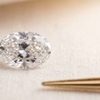
When choosing an oval diamond, the most critical metric beyond the 4Cs is the length-to-width ratio (L/W ratio). At one carat, a 1.30:1 oval and a 1.50:1 oval read as two completely different stones.
Industry consensus places 1.35:1 to 1.50:1 as the golden ratio, the range where visual presence and elongation balance most elegantly. But choosing 1.35, 1.40, 1.45 or 1.50 depends on your hand shape, band style, and personal aesthetic.
This article decodes the visual character of each ratio and the contexts where each shines. Begin with the best diamond shape guide for cross-cut comparisons.
What Is L/W Ratio and How Is It Calculated?
The L/W ratio is simply diamond length divided by width. An oval that measures 7.7 mm long by 5.5 mm wide has an L/W ratio of 7.7 ÷ 5.5 = 1.40:1. GIA certificates display these measurements directly.
Higher ratios give a more elongated stone; lower ratios appear more rounded. Approaching 1.00:1, the stone resembles a round; above 1.55:1 it edges toward marquise-like slenderness. The diamond certification institutions guide explains how to read GIA certificates.
1.30:1 Rounded: The Subtle Oval
A 1.30:1 ratio is the most rounded oval option. These stones sit between a round and a standard oval, projecting a classical, understated character.
Strengths: more even brilliance, less pronounced Bow-Tie effect. Weaknesses: insufficient elongation, missing the visual signature of an oval. The diamond 4Cs explained guide explores cut balance in depth.
Best suited to: Long, well-proportioned fingers where natural hand geometry already provides ideal lines.
1.35:1 to 1.40:1 Classic: The Eternal Golden Ratio
This range is the most popular and timeless oval ratio. It strikes a perfect balance between elongation and visual weight, neither too rounded nor too narrow.
The Princess of Wales's heirloom sapphire ring and Taylor Swift's engagement ring both fall within this band. Read 30,000 in-stock diamonds at ALUXE for ALUXE's curation within this range.
Best suited to: Almost every hand type. The safe and sophisticated default when undecided.
1.45:1 to 1.50:1 Elongated: Strong Modern Aesthetic
Today's most-watched celebrities favour this range. Hailey Bieber and Meghan Markle both wear ovals between 1.45:1 and 1.50:1.
Strengths: striking elongation, projecting a slim and elegant finger profile. Weaknesses: Bow-Tie shadows are more likely, particularly approaching 1.50:1, requiring careful in-person inspection. Read Hollywood star wedding rings for celebrity case studies.
Best suited to: Shorter fingers, prominent knuckles, or anyone seeking maximum elongating effect.
1.55:1 and Beyond: A Bold Distinct Choice
Ovals exceeding 1.55:1 begin to read like a marquise cut. These stones carry strong personality, but Bow-Tie risk reaches its highest, and brilliance distribution can become uneven.
Unless you specifically pursue extreme elongation, this range is generally not recommended. Browse the meaning behind engagement ring styles for alternative shape options.
Best suited to: Very long fingers and those wanting a distinctive personal aesthetic.
Pairing Band Styles With L/W Ratios
Band style influences how a given ratio reads on the hand.
Solitaire band: Pairs best with 1.35:1 to 1.45:1. Without accent stones competing for attention, the centre stone's elongation reads cleanly.
Halo setting: Pairs best with 1.40:1 to 1.50:1. Halo accents make a stone read more rounded, so a slightly elongated ratio rebalances the silhouette. Read top 3 engagement rings she'll say yes to for setting examples.
Three-stone setting: Pairs best with 1.40:1 to 1.50:1. Side stones add visual width, so an elongated centre stone preserves overall elegance.
Vintage gold band: Pairs best with 1.30:1 to 1.40:1 for antique character. Read K gold price differences for how metal tone interacts with stone choice, and the carat element guide for how carat weight pairs with ratio.
Try and Compare: Find Your Personal Golden Ratio
No theoretical framework replaces actually trying rings on. Visit an ALUXE boutique and try 1.35:1, 1.40:1, and 1.50:1 ovals on the same finger, photographing each for direct comparison.
Hand shape, skin tone, and personal style differ for everyone. Your true golden ratio only reveals itself when worn. The ring style hand shape guide helps establish a complete assessment workflow, and love in the ring shares refined selection tactics.
If your budget allows, custom wedding ring recommendations with acredo shows how German craftsmanship builds rings around your preferred ratio. Pair this with the perfect engagement ring guide for clear decision logic.
Begin Your Brilliant Journey
Want to dive deeper into oval diamond ratios? Explore the GIA diamond knowledge centre to sharpen your selection skills, or browse the engagement ring collection for your destined style. Ready to see oval brilliance in person? Book a boutique consultation and let our specialists tailor recommendations to you.
References
Editor's Note
After writing this piece, one realisation stayed with me: the oval's L/W ratio is essentially a language of identity. A 1.35:1 reads quietly graceful; a 1.50:1 reads boldly assured. Choosing a ratio is choosing how you want the world to perceive you. There is no right answer, only the one most like you. Spend an afternoon at an ALUXE boutique trying three ratios side by side, and the answer arrives with a kind of certainty no spreadsheet could deliver.
FAQ
讓你們的故事,也擁有專屬的光芒
ALUXE 陪伴過無數新人記錄他們的愛情故事。我們相信,每一段感情都值得被用心對待,也值得一枚能代表你們的戒指。 無論你們的故事是浪漫、低調、冒險或充滿驚喜,我們都能為你們找到最合適的象徵。